


Representation of Disability
in Children’s Books
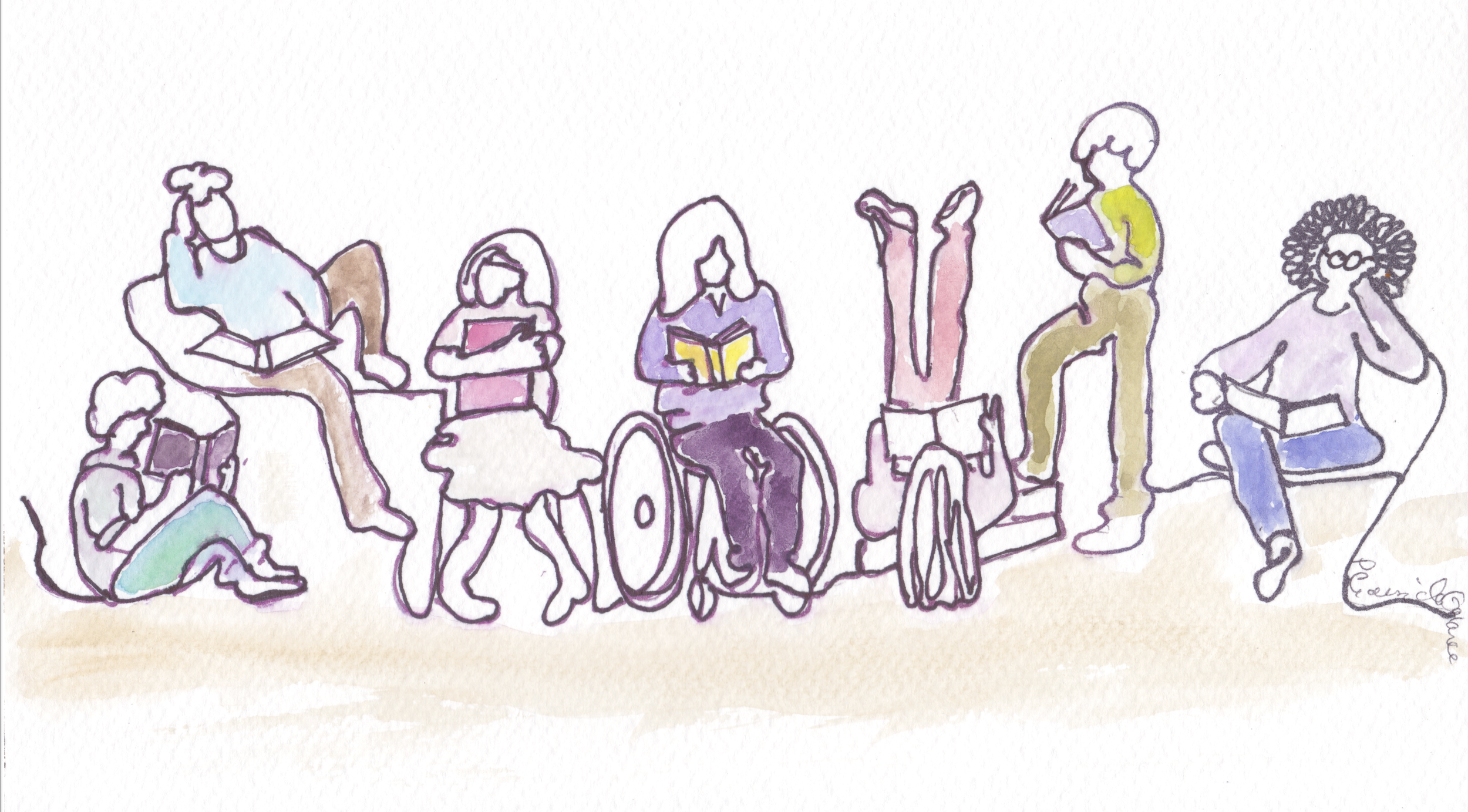
Representation of Disability in Children’s Books
Representation Matters is a collaborative project rooted in the belief that inclusive cultures begin with our children. First envisioned by Linda, Janet, and Patricia, this initiative uses children’s literature as a powerful vehicle for dialogue about disability representation and inclusive education. Through shared inquiry and reflection, we explore how children’s books shape perceptions of disability and influence how young readers understand themselves and others.
While we celebrate the growing availability of children’s books that include disability, both explicitly and incidentally, we also recognize ongoing gaps. Educators and families continue to seek representations that are authentic, intersectional, and inclusive of children with significant support needs and those who are culturally, linguistically, and racially diverse. Through this work, we aim to support more equitable, empathetic, and affirming connections for all children.
This project braids together our distinct experiences and perspectives, modeling the collaborative practices needed to select and use authentic, meaningful children’s literature in homes and classrooms. Our process is iterative and evolving; Representation Matters is a journey rather than a destination, one that continues to push us toward greater criticality, reflection, and care.
We invite educators, families, researchers, and advocates, with and without disabilities, to join us in this exploration. Engage with the texts, reflect on the messages they convey, and participate in dialogue that challenges assumptions and expands understanding. Together, we can shape more inclusive classrooms, homes, and communities … one story, one conversation at a time.

-
Why look at children’s books?
Children's books can be the vehicle for wonderful dialogue! This dialogue, or as Paulo Freire calls it “conscientização“, is learning that wakes up our minds, digs into our inner thoughts, and helps transform our thinking. Conversations around a table through children’s books surface dialogue that helps us see the world from multiple perspectives. This dialogue helps us gain new understanding and become generative in our ways of knowing. Once we see these new insights, our lives become richer, the world becomes brighter, we are more in tune with others, and in our own humanity. What power children's books have! Children’s books have power because, by design, they are simple yet contain complex ideas through their words, through their pictures, through their composition.
Many scholars use children's books in this dialogical way. There are many critiques of children's books. There are many checklists to evaluate children's books. These approaches, although useful, are not our project’s goal. We hope through conversations of children's books to capture the nuances of humanity underpinning the text. We hope that our conversations do not pass judgment on the book but open up dialog for understanding others and ourselves. We use children's books as an entrance to begin these transformative conversations. Our critical dialogues ask us to look beyond the words and the pictures. We ask ourselves questions like:
· what is missing?
· what ideas does this reinforce for me?
· what ideas make me pause and ponder and wonder?
· what about this book represents my humanity?
Many scholars use children's books, like we are, as vehicles for conversations. Conversations about equity and about justice. We hope to join these conversations and ask wonderful questions like:
· Whose stories are represented?
· Whose stories are missing?
· Who's telling the story?
Our work joins this critical dialogue through the lens of disability and intersectionality.
-
We examined the representation of disability in children's literature, employing a critical analysis approach. From a disability studies stance, we reviewed scholarship, categorized, and defined key aspects of evaluative criteria. Through a process of consensus and structured tabular methodology, we analyzed and expanded the criteria. Not satisfied with a checklist approach, we created a continuum of descriptors for a more dynamic framework for the portrayal of disability in literature. As we share our insights with others, we iteratively refine the framework labels and definitions to capture the nuances of representation.
-
When selecting books (see our evolving booklist)
Know the purpose
Know the audience
Although there are many checklists and guides, we suggest using the bookmark continuum with a critical friend in discussion.
Most important is your planned facilitation!
-
Representation Matters: Use this framework when selecting books that feature diverse disabled characters, ensuring they are authentic and reflect the local context.
Feature Disabled Voices: Prioritize literature written by authors with disabilities to ensure authentic perspectives.
Avoid Stereotypes: Be mindful of stereotypes and tropes commonly associated with disability, and choose literature that challenges and subverts these narratives.
Promote Accessibility: Present books in multiple formats.
Encourage Critical Thinking: Facilitate discussions that encourage students to critically analyze portrayals of disability in literature and challenge ableist assumptions.
Honor Diversity: Emphasize the value of diversity and inclusion in literature, highlighting the unique contributions and perspectives of individuals with disabilities.
Provide Supportive Environment: Create a learning environment that is inclusive and supportive of all, ensuring everyone feels valued and respected.
Engage with a Community of Reflective Practice.
-
We propose a model to inform practice using a comprehensive and nuanced approach to engage with children’s literature through a critical lens for disability representation. This model recognizes the complexities of educators’ responsibilities to create a learning environment where all students are seen and valued. This approach supports deeper exploration and understanding by providing a dynamic lens through which to comprehensively examine character development, relationships, quality literature, reader experience, anti-ableism, protagonist, inclusivity, self-determination, and author purpose. By design, this model encourages critical thinking and facilitates the identification of patterns and themes within the text, fostering rich insights into how disability and diversity are portrayed and interpreted. Download a bookmark here
-
Banfield, B. (1998). Commitment to change: The Council on Interracial Books for Children and the world of children's books. African American Review, 32(1), 17-22.
Beckett, A., Ellison, N., Barrett, S., & Shah, S. (2010). ‘Away with the fairies?’ Disability within primary-age children's literature. Disability & Society, 25(3), 373-386.
Bishop, R. S. (2016). A Ride with Nana and CJ: Engagement, appreciation, and social action. Language Arts, 94(2). 120-123.
Blaska, Joan K. (2004). “Children’s Literature That Includes Characters With Disabilities or Illnesses.” Disability Studies Quarterly 24(1). http://dsq-sds.org/article/view/854/1029.
Botelho, M. (2021). Reframing mirrors, windows, and doors. A critical analysis of the metaphors for multicultural children’s literature. Journal of Children’s Literature, 47(1). 119-126.
Brown, M. R. (2017). ‘‘Swimming Against the Tide’’: Disability Represented Through Fish Symbolism in (and on) Middle Grade and Young Adult Novels. 17 October 2017. Springer Science + Business Media, LLC
Council on Interracial Books for Children (1980). Guidelines for Selecting Bias-Free Textbooks and Storybooks.
Crawford, S. C. (2016). More than a wheelchair in the background: A study of portrayals of disabilities in children's picture books.
Derman-Sparks, L. (1989). Anti-bias curriculum: Tools for empowering young children. National Association for the Education of Young Children, 1834 Connecticut Avenue, NW, Washington, DC 20009-5786.
Digman, E. (2021). Content Analysis: Representation of Down Syndrome in Children’s Literature. UWL Journal of Undergraduate Research XXIV
Faeth, E. M. (2021). Agency, power, and disability: A textual analysis of The Silence Between Us. Children's Literature in Education, 52(4), 433-448.
Kaplan, A. G., Tobin, C., Dolcetti, T., & McGowan, J. (2022). Representation Matters: Board Books with Children with Disabilities. Children & Libraries, 20(3), 15.
Kleekamp, M. C., & Zapata, A. (2019). Interrogating depictions of disability in children's picture books. The Reading Teacher, 72(5), 589-597.
League, A. D. (2005). Evaluating children’s books that address disability. Retrieved February 7, 2017.
Lee, J., Bornat, J., Dierks, K., Erkulwater, J. L., Brockelman, K. F., Getzel, E. E., ... & Leidy, P. (2007). From the Editor’s Desk: Introducing Associate Editor Alex Lubet. Review of Disability Studies: An International Journal, 3(3).
Myers, C., & Bersani, H. (2008). Ten quick ways to analyze children’s books for ableism. Rethinking Schools, 23(2), 1-5.
O'Connell, S. J. (2011). Autism AZ: a resource to increase awareness amongst general educators.
Oslick, M. E., & Pearson, M. (2016). Evaluating and Using Literature, Including People with Disabilities in All Classrooms. Journal of the American Academy of Special Education Professionals, 104, 118.
Pennell, A. E., Wollak, B., & Koppenhaver, D. A. (2018). Respectful representations of disability in picture books. The Reading Teacher, 71(4), 411-419.
Prince, A. M., & Hayden, H. E. (2022). Repositioning disability in children’s picture books through classroom read-alouds. Teaching Exceptional Children, 55(1), 30-38.
Schneider, J. J. (2016). Important Books.
Schneider, J. J., Marj, & Moss, D. J. (2004). Disabled Characters in Children’s Literature. CT State Department of Education.
Shah, N., Ortiz, N., Stroupe, D., & Reinholz, D. (2021). Who participates? Analyzing data with context can help educators detect inequalities in classroom participation and reduce implicit bias. Educational Leadership, 78(6), 41-46.
Slapin, Beverly; Lessing, Jill Belkind, Elaine. (1987). Books Without Bias: A Guide to Evaluating Children’s Literature for Handicapism. Berkeley, CA: KIDS Project.
Tondreau, A., & Rabinowitz, L. (2021). Analyzing representations of individuals with disabilities in picture books. The Reading Teacher, 75(1), 61-71.
Wopperer, E. (2011). Inclusive Literature in the Library and Classroom: The Importance of Young Adult and Children’s Books That Portray Characters with Disabilities. Knowledge Quest. 39(3), 26-34.
Worotynec, Z. S. (2004). Contrived or inspired: Ability/disability in the children's picture book. Disability Studies Quarterly, 24(1).
“I love the bookmark! ... Really cool that a resource can guide discussion, but then can be tucked into the book for future use!.”
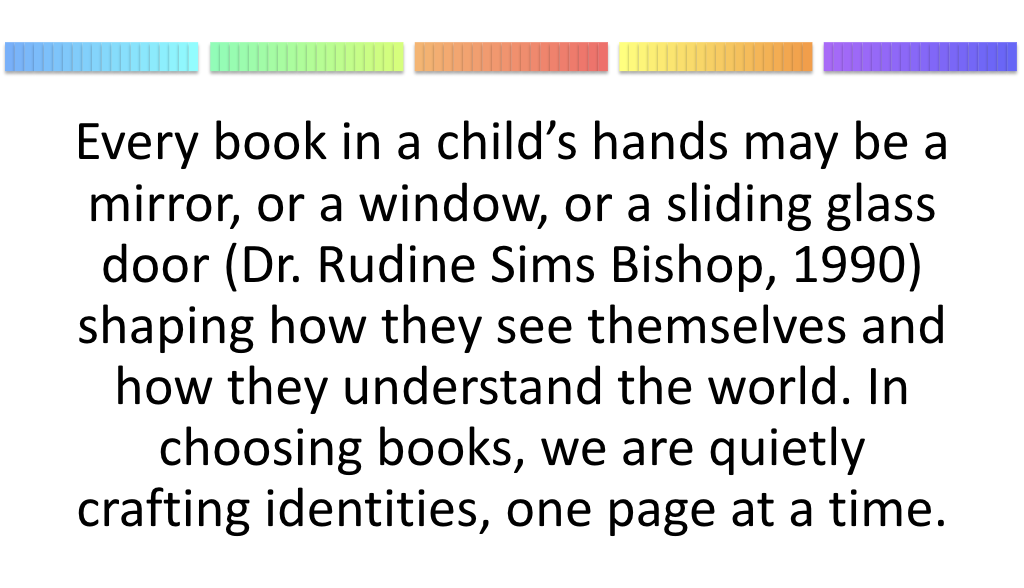
Our model for critical analysis of representation
To facilitate discussion, we have developed an evolving “model” to evaluate representation and support the critical reading of books.
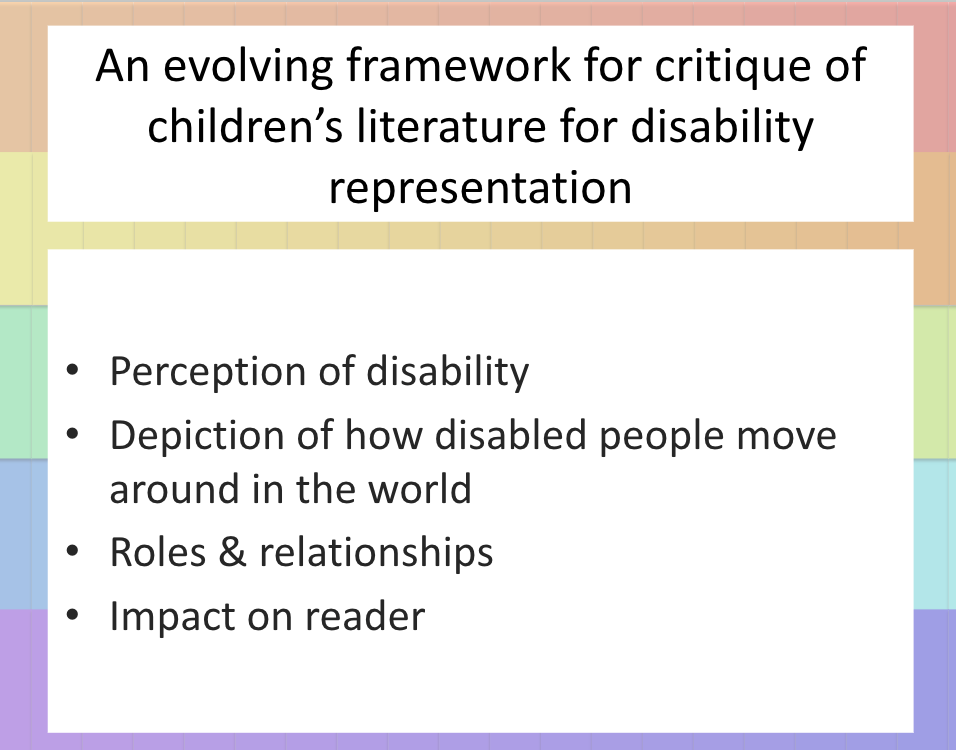
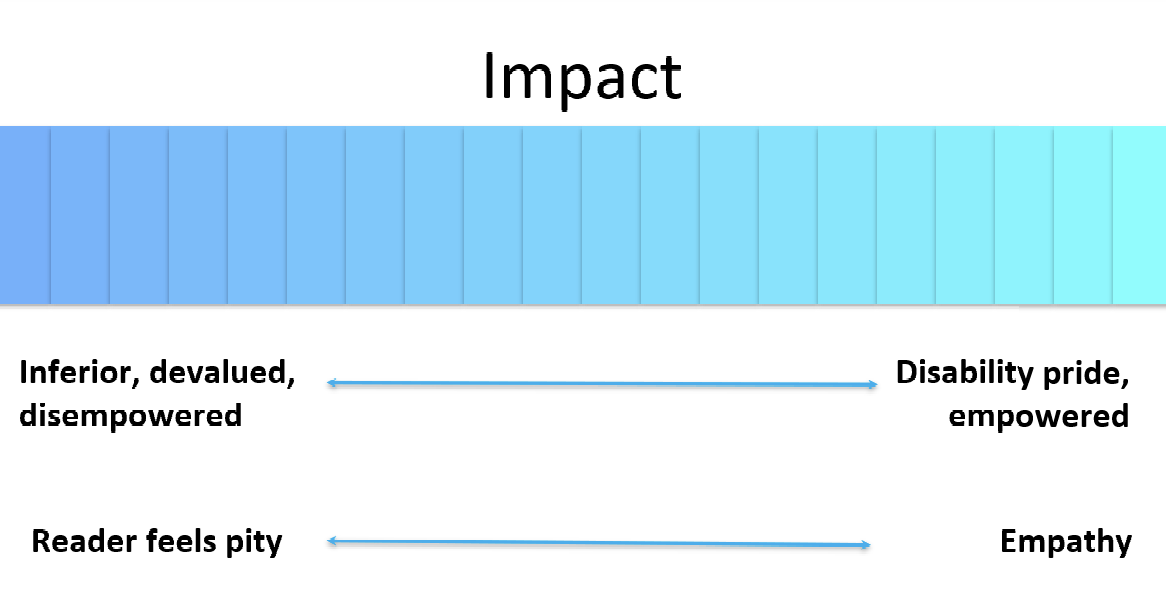
Identity Affirming Text Representations
“To foster an inclusive classroom and build upon all children’s strengths, the texts that children interact with must contain accurate and positive depictions of disability,” not limited to teaching explicitly about disability, but through rich, natural descriptions and events (Meyer, 2021, p. 30). “Identity-affirming texts and passages are those that give all students the opportunity to see themselves reflected in what they’re reading. By introducing students to texts that portray characters and real-life people from diverse cultures and languages, varied family structures, a range of abilities and disabilities, and different gender identities, educators deepen the teaching of literacy by connecting it directly to students’ own lives and the lives of their peers.”

Our Journey
-

A culture of belonging in children’s literature
Our first iteration of the framework was presented at the 39th Annual Pacific Rim International Conference on Disability and Diversity, February 2024, in Honolulu, Hawai’i. A culture of belonging in children’s literature: A framework for critical analyses was developed with a literature review looking at indicators of inclusive children’s literature.
-
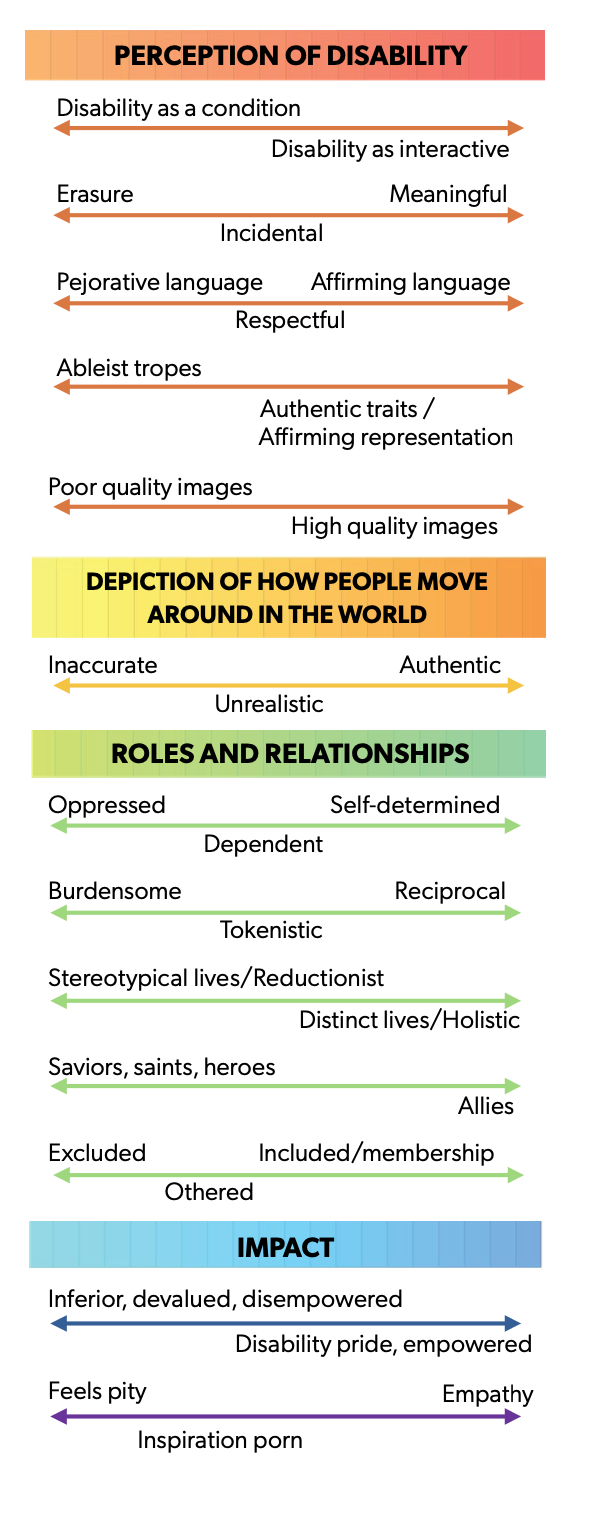
Meaningful disability representation
We enjoyed sharing an interactive session on the complexities of using children’s books with meaningful disability representation at TASH 2025 in Denver, Colorado. We used this continuum, walked through examples, and then explored books using the continuum as a discussion guide
-

Connecting communities through books
Our goal is to create a community dedicated to critically analyzing literature and discovering new ways to use books effectively. We worked with bookstores, university student groups, book clubs, and literacy organizations to gather feedback on our continuum and framework. Through our discussions, we will explore how books can represent all children and provide insight into diverse experiences.
Join our Journey
Sponsored by
Dr. Linda Shandrick Lengyel, Dr. Janet Story Sauer, and Dr. Patricia Crain de Galarce
Host a Book Discussion
Are you interested in engaging in discussions on authentic representation and diverse voices?
We hold book discussions in University Classrooms, at conferences, at bookstores, in living rooms, and in public libraries in hopes of creating a community of educators dedicated to critically analyzing literature and discovering new ways to use diverse texts effectively..